The internet is the heartbeat of the modern home. We’ve come to rely on it for work, education, entertainment, and staying connected to the people who matter most. So, when it slows down, cuts out, or just can’t keep up — that’s a real problem.
Fiber-optic internet is the solution.
It’s faster, more reliable, and built for the way people use the internet today — with multiple devices, video calls, 4K streaming, gaming, and everything else running all at once. This is a crash course in what fiber-optic is, how it works, and why more households are making the switch.
Read More
- How does fiber internet work?
- A quick history of fiber-optic internet
- How fast can fiber-optic internet go?
- Why is fiber-optic internet faster?
- What are the benefits of fiber-optic internet?
- How is fiber-optic different from cable, DSL, 5G, and satellite internet?
- Watch out for “phony fiber-optic”
- Is fiber-optic internet the best internet?
- How do you get fiber-optic internet?
- How do I find fiber-optic internet in my area?
- Common questions about fiber-optic internet
What is fiber internet?
Fiber internet is a high-speed internet connection that transmits data using pulses of light through thin strands of glass called optical fiber. Instead of sending electrical signals through copper wires like cable or DSL, fiber-optic uses light — which means it can carry far more data, far faster, with far less interference.
Here’s what that means for your everyday experience. Fiber-optic is:
- Fast — 1,000 Megabytes per second (Mbps) (1 Gigabit) of fiberr internet upload speed is about 20 times faster than standard cable. Fiber internet also wins in terms of consistent and reliable speeds. Cable speeds fluctuate based on weather, temperature, and how many homes are on the same node (typically 100-500 homes share a node). Fiber-optic is less susceptible to erosion and has way more bandwidth – enough to support a much larger network over time.
- Reliable — IQ Fiber provides dedicated bandwidth directly to you, so your speeds don’t dip during peak traffic hours or as more neighbors join the Fiberhood.
- Symmetrical speeds — Only fiber internet has symmetrical performance. Upload as fast as you download. No matter what you’re doing, you can get it done quickly.
- Future-Proof — Fiber-optic lines are more lightweight, durable, and resilient than copper. They have enormous capacity, far exceeding what any home or business requires, making it ready for whatever technology comes next.
- Energy efficient — Traditional cable internet uses about 12 times more energy than fiber-optic internet. It generates less heat and is made from more sustainable materials.
How does fiber internet work?
Fiber transmits data as pulses of light through strands of glass or plastic. Think of it like Morse code — but instead of dots and dashes, it’s rapid flashes of light traveling at nearly the speed of light itself.
Fiber internet’s speed comes from the high frequency of those light signals. Higher frequency means more bandwidth. Picture a flashlight turning on and off incredibly fast to communicate data. Fiber-optic’s flashlight turns on and off so fast it can transmit more data per second than any other type of network.
Fiber internet also has lower latency, which is the time it takes for data to travel from your device to a server and back. This is because the data travels at the speed of light and stays well-preserved inside its cable. That means no boosting, copying, or repeating needed, which shortens the time it takes to get from point A to point B.
Here’s the basic path data will take through a fiber-optic connection to reach your devices:
- Data centers and internet exchanges send data as light through fiber-optic cables.
- Fiber-optic lines run from your internet service provider’s network to your neighborhood or building.
- A fiber-optic drop connects directly to your home or business.
- An Optical Network Terminal (ONT) converts the light signal into a signal your router and devices can use.
Light in, internet out. No shared copper lines. No signal degradation over long distances. No slowdowns when your neighbor starts streaming at 8 p.m. Just fast, steady internet when you need it.
A quick history of fiber-optic internet
Fiber-optic technology isn’t new. The idea of transmitting light through glass fiber starts in the 1800s. The modern version was developed in the 1970s, and by the 1980s and ’90s, fiber-optic was already being used to carry internet traffic across major communication networks around the world.
Here’s something that might surprise you: you’re reading this right now because of lightning-fast fiber-optic cables running under the ocean. The backbone of the internet was built on fiber.
What changed in recent years is the “last mile” — the final connection between that powerful backbone and your home. For decades, that connection relied on copper. Now, fiber-optic has started reaching homes and businesses directly, replacing old infrastructure that wasn’t designed for today’s internet demands.
Every day we use the internet for video calls, 4K streaming, cloud storage, smart devices, and remote work — all running simultaneously. This stretches copper networks way past what they were originally built to handle – cable TV. Fiber-optic internet connection is what comes next.
How fast can fiber-optic internet go?
Fiber-optic technology has been tested in laboratory settings at speeds exceeding 1 petabit (1,000,000 gigabits) per second — far beyond residential and most commercial needs. Fiber internet plans typically range from 250 Mbps to 5 Gbps.
Here’s what those real-world speeds look like:
- 250 Mbps: Great for 1-2 person households. Multiple streams, video calls, and gaming all run at the same time without breaking a sweat.
- 1 Gig: Ideal for larger households and small businesses with lots of connected devices. Streaming, smart home systems, and work — all at once, no problem. This is about 20 times faster than standard cable.
- Multi-Gigs speeds: Designed for homes and businesses with intensive digital demands. There are essentially no limits: it supports streaming 4K on every TV, competitive gaming, a full smart home setup, and work-from-home demands all running simultaneously without a second thought.
Why is fiber-optic internet faster?
We know fiber-optic is faster, and it’s not even a close race. Cable, DSL, 5G and satellite internet aren’t in the same league.
Fiber internet can deliver speeds all the way to 5 Gbps or more. Standard cable tops out well below that — and those speeds aren’t always consistent.
Two key reasons:
- Symmetrical speeds. Cable internet companies have gotten away with slow upload speeds for years because most households downloaded more than they uploaded, but that’s no longer true. Cloud programs, video conferencing, and streaming all require strong upload speeds. Only fiber-optic internet gives you the same speed in both directions. So, whether you’re uploading, downloading, or doing both at the same time across multiple devices, you won’t hit a wall.
- Consistent performance. IQ Fiber provides dedicated bandwidth directly to your home. Your speed at 9 p.m. is the same as your speed at 9 a.m. because our modern fiber-optic network is built to handle the bandwidth needed to run your entire community without experiencing that spinning wheel on your screen (called a throbber).
Is fiber the fastest kind of internet?
For home and business use, yes. Fiber-optic is the fastest widely available internet technology today. No other residential connection type reliably delivers symmetrical multi-gigabit speeds with low latency and consistent performance.
Cable can approach fiber-optic on download speeds in ideal conditions, but it doesn’t come close on upload speeds, consistency, or dedicated bandwidth. 5G can be fast, but it’s variable. All other technology is measured against fiber-optic technology because it’s the new standard.
What are the benefits of fiber-optic internet?
Speed gets most of the attention. But it’s not the only reason fiber-optic stands out. Here’s what makes a difference day to day:
- Lightning-fast speeds. Fiber is faster, clearer, and capable of traveling far longer distances than coaxial cable. Stream HD video, download large files, game online — no buffering, no lag.
- Enhanced reliability. Cable’s electrical signals are vulnerable to extreme temperatures, and electrical storms. Copper and aluminum also rust and erode over time. Fiber-optic uses glass and light — unaffected by weather, interference, or physical degradation. Stable connection, even during peak usage or bad weather.
- High performance network. Cable connects multiple homes to the same line and divides bandwidth among users. During peak hours, that shared connection gets squeezed and users experience degraded service. Because fiber-optic networks have so much more capacity, users experience no congestion.
- Low latency. Light pulses stay well-preserved as they travel through the network, requiring less processing along the way. Near-instant response times which are critical for gaming, video calls, and anything where a split-second delay matters.
- Future-proof technology. Fiber-optic’s bandwidth capacity far exceeds what society currently needs, even well into the future. A single strand of fiber can handle an entire household’s internet connection without sacrificing speed, no matter how many devices are connected.
- Energy efficient. Traditional cable uses about 12 times more energy than fiber. It generates less heat and is made from more sustainable materials which is better for your home and the environment.
How is fiber internet different from cable, DSL, 5G, and satellite internet?
Not all internet is created equal. Here’s how the main options compare:
Cable Internet
Uses coaxial copper cables originally designed for cable TV to transmit electrical signals. Widely available but built on shared infrastructure. Multiple homes connect to the same node and pull from the same bandwidth pool. During peak evening hours, everyone’s speeds drop even if your plan advertises 500 Mbps. Cable download speeds typically fall between 10 Mbps and 200+ Mbps, with upload speeds significantly lower.
DSL
Runs over copper phone lines. Widely available in rural and suburban areas, but performance degrades the farther you are from your provider’s equipment. For basic browsing, it can get the job done, but it struggles with multiple devices or heavier usage.
5G Home Internet
Delivered wirelessly via cellular towers. Convenient, but it’s worth clearing up a common misconception: “5G” doesn’t mean 5 gigabytes of speed. It’s the wireless frequency used to deliver service. Performance varies based on distance from a tower, building materials, and network congestion. Like cable, 5G towers share capacity among users so as the whole neighborhood gets home from work, that shared signal starts to decline.
Think of 5G like freeway at rush hour. Fiber-optic is the off-ramp that goes directly to your home.
Satellite Internet
A real option in rural areas where other types aren’t available. But even modern low-orbit satellite service carries higher latency than fiber-optic or cable, and speeds fluctuate with weather and network load.
Fiber-optic Internet
Uses glass strands and light instead of copper and electricity. That gives fiber-optic far more capacity than traditional cable networks, helping deliver faster speeds, symmetrical uploads and downloads, and more consistent performance throughout the day. It is also less vulnerable to interference and signal degradation.
Watch out for “phony fiber”
Every internet provider uses fiber-optic lines for the heavy lifting, including connections between major data centers and internet hubs. Non-FTTP providers use coaxial cable, 5G wireless, or phone lines for that final stretch, and that last mile bottlenecks your entire connection. They call this “Fiber Backed” or “Fiber Powered” orsomething similar.
True fiber-optic internet service — often called fiber-optic-to-the-premise (FTTP) — runs fiber-optic directly inside your premise. That’s what enables the full benefits of speed, reliability, symmetrical bandwidth, or lower latency that real fiber-optic delivers without complications from other technology.
When shopping for fiber-optic internet, confirm you’re getting a true FTTP connection. With IQ Fiber, that’s exactly what you get.
Fiber-optic internet is the best internet. No question.
For most households and businesses, yes. If fiber-optic is available where you live or work, it’s almost certainly the best choice.
The question isn’t really whether fiber-optic is faster, more reliable, and more stable— it is. The question is whether the difference matters in your situation. If you’re a single person doing light browsing, your current service might be fine. But if you’ve ever dealt with:
- Buffering or slowdowns when multiple people are home
- Video calls that freeze at the worst possible moment
- Internet that slows down every evening like clockwork
- Uploads that feel like they take forever
…then fiber-optic isn’t just an upgrade. It’s the fix.
And if fiber-optic isn’t in your area yet, it’s worth knowing: access to a fiber-optic connection can increase your home’s value by up to 4%. It pays to be in a fiber-optic neighborhood.
How do you get fiber-optic internet?
Availability depends on whether infrastructure has been built in your area. Fiber-optic requires physical cables to be laid, which is a meaningful time and cost commitment to build new networks. That’s why IQ Fiber is focused on expanding to more neighborhoods and making high-speed, reliable fiber internet accessible to everyone.
Here’s the general process:
- Check availability. Search for fiber internet providers in your area or use the address lookup tool on IQ Fiber’s website.
- Choose a plan. Plans are tiered by speed from 250 Mbps to 5 Gig. Choose based on how many people are in your household and how you use the internet.
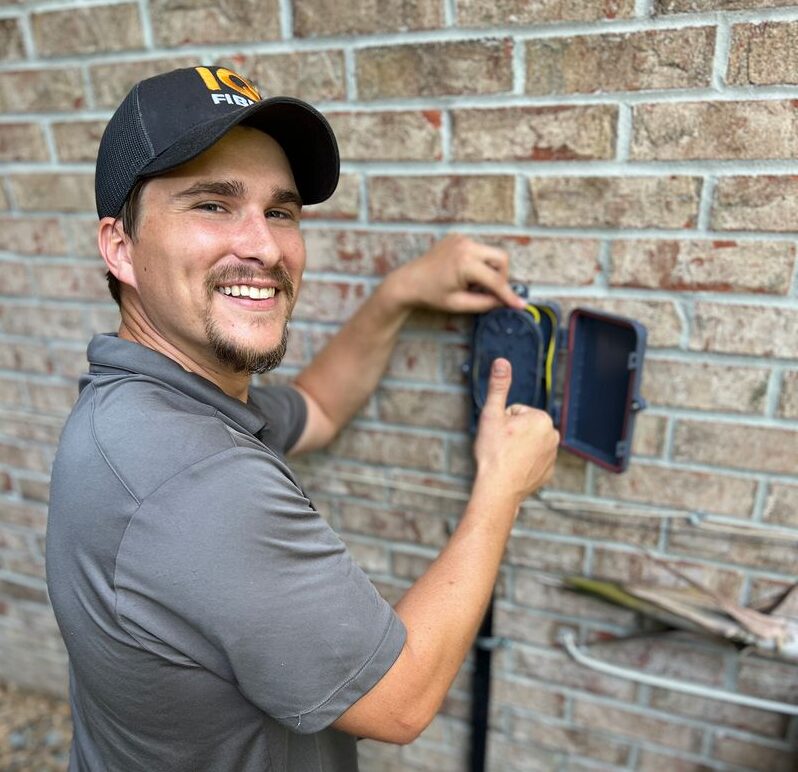
- Schedule installation. Fiber internet requires a technician visit to run the connection to your home and install the ONT. Unlike cable, fiber-optic can’t just use existing lines.
- Get connected. Once the fiber-optic line is in, your router connects to the ONT and your WiFi works like it always has — just with far more bandwidth coming in.
How is fiber-optic internet connected and installed?
A technician runs a fiber-optic drop cable from the nearest fiber-optic line to your home — either underground or overhead, depending on your neighborhood’s infrastructure. There are a few different connection types:
- Fiber to the home (FTTH): cables run directly from the network to your house. The fastest and most reliable option and what IQ Fiber delivers.
- Fiber to the curb: Fiber-optic runs to a nearby utility pole or cabinet, then a coaxial cable completes the connection to your home. Still fast, but a step down from true FTTH.
- Fiber to the node: Fiber-optic connects to a neighborhood hub, then coaxial cable runs the rest of the way. The slowest of the three and technically a hybrid, not pure fiber-optic.
Inside your home, the technician installs a small device called an ONT. It converts the light signals from the fiber line into electrical signals your router and devices can use. The whole process typically takes a few hours, and most customers are up and running the same day.
Once it’s in, you don’t have to think about it. That’s kind of the point.
How do I find fiber internet in my area?
The easiest way is to check IQ Fiber’s availability tool at iqfiber.com — just enter your address and see if we’ve reached your neighborhood. You can also check the FCC’s broadband map or ask neighbors which provider they’re using.
If IQ Fiber hasn’t made it to your street yet, submit your information to stay informed. We’re constantly expanding, and we believe everyone deserves access to a fast, reliable fiber-optic connection.
Why does cable internet slow down at night, but fiber-optic internet doesn’t?
This is one of the most common frustrations cable customers deal with — and it’s not random. It happens at 7 or 8 p.m. every night because of how cable is built.
Cable relies on shared nodes. Your home and dozens of your neighbors are all pulling from the same bandwidth pool. When everyone gets home and starts streaming, gaming, and jumping on video calls at the same time, that shared bandwidth is divided among users. A plan advertised at 500 Mbps might deliver closer to 150 Mbps when the whole neighborhood is online. There simply isn’t enough capacity in most cable nodes to keep up with actual user demand at peak use periods of time.
Fiber-optic doesn’t work that way. Fiber internet delivers vastly more capacity directly to your home. Your neighbor streaming four shows at once has zero effect on your speeds. It’s yours — consistently — at 2 p.m. or 9 p.m., quiet Tuesday or busy Friday night.
Cable was designed for a world where people watched TV on cable and used the internet occasionally. Fiber-optic internet was built for now.
Common questions about fiber-optic internet
Does fiber-optic internet require a special router?
Not necessarily. Most fiber providers — including IQ Fiber — will supply or recommend a compatible router. The ONT connects to a standard router, and your WiFi works like it always has, just with a lot more bandwidth coming in.
That said, if you’re upgrading to gigabit speeds, make sure your router can take advantage of them. A router that maxes out at 300 Mbps won’t deliver your full 1 Gig plan. For multi-gig, you need a router that can handle the multi-gig speeds and also has multi-gig capable ethernet and wi-fi (i.e. WiFi 7).
Is fiber-optic internet good for gaming?
Absolutely. And not just because of raw speed. Latency is where fiber-optic really shines. Lower latency means more responsive gameplay, fewer lag spikes, and less of that infuriating moment where your connection drops right when it matters most.
Is fiber-optic internet good for working from home?
It’s the best setup you can have. Working from home puts heavy demands on upload speeds including video calls, file sharing, cloud backups, virtual desktops. Cable often underdelivers on uploads even when downloads look fine. With fiber-optic’s symmetrical speeds, your video call looks as clear on the other end as it does on yours, and your files upload just as fast as they download.
Does fiber-optic internet work during a power outage?
The fiber-optic line itself isn’t affected by power outages because it’s light traveling through glass, not electricity. But your ONT and router require electricity to operate. If your power goes out, your internet goes out with it unless you have a battery backup in place.
Does fiber internet increase home value?
Yes. Studies show that access to a fiber-optic internet connection can increase a home’s value by up to 4%. As more buyers expect fast, reliable internet as a baseline, being in a fiber-optic-served neighborhood is a genuine advantage.
Ready to make the switch?
Check your address and explore IQ Fiber plans at iqfiber.com. If we haven’t reached your neighborhood yet, submit your information and we’ll keep you posted.
Want to figure out exactly which speed is right for your household? Check out: Is 500 Mbps Fast Enough?